17 Nov 2026
"A police reform worth pursuing."
NPCC Chair opens the 2026 Summit
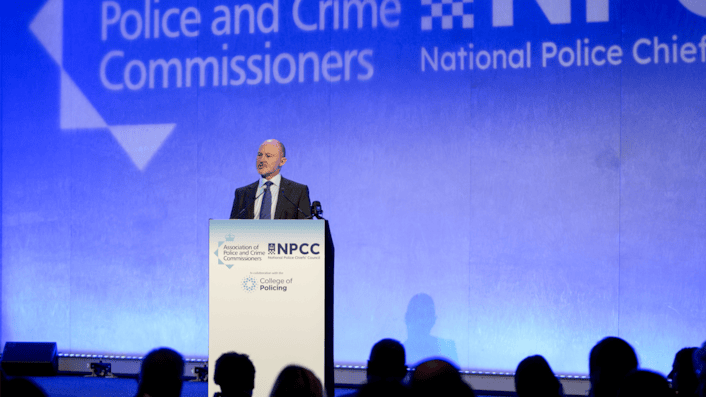
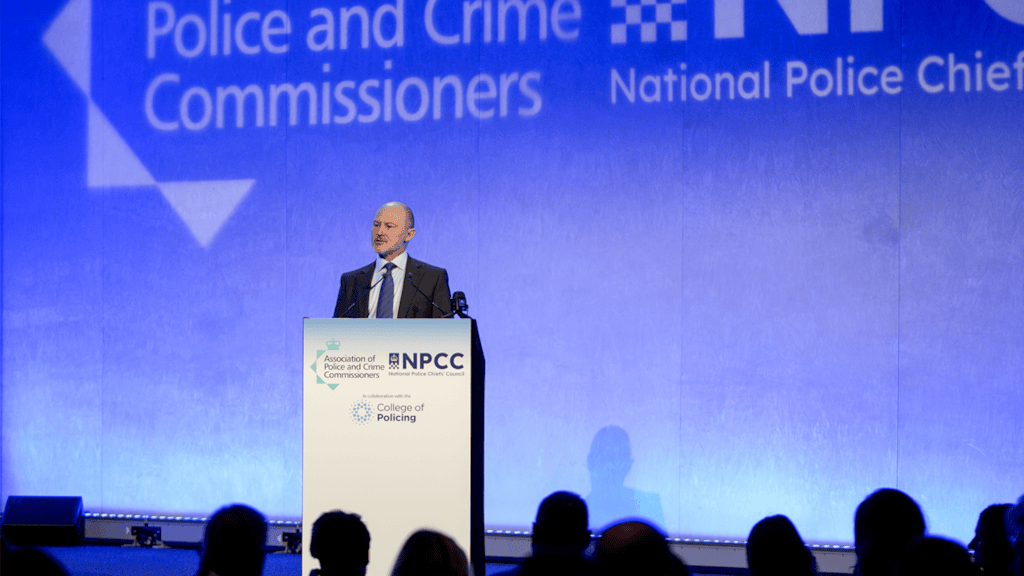
National Police Chiefs' Council Chair, Chief Constable Gavin Stephens, today opened the NPCC APCC Summit in London with his ambition for police reform:
Before I start, I really would like to pay tribute to Emily and all of the team at APCC.
With the announcement on changes to governance coming so close to last year's event, despite that we've enjoyed a really productive year of working together, where we can honestly debate our differences and disagreements and try to find common ground.
And of course, over the next couple of days, those conversations are going to continue and are likely to focus a lot on police reform. On how policing is organised, funded and governed. All important topics, of course.
But in this, I really don't want us to lose sight of why we're doing this in the first place.
I always refer back to two tests, two very simple questions that have carried me through my policing career.
The first: are we making people safer?
The second: are we making them feel safer?
Now, these are different things, but both matter. Every change that we enter into, every pound we spend, ought to help us do both.
As I've mentioned before at these events, I grew up on the north-east coast in the 1970s and 1980s.
It was a difficult time economically. There are some shadows of now. High youth unemployment. The decline of some industries yet to be replaced by the new. And, like now, even concerns over existential risks.
I still remember at school the public education material on nuclear conflict, and being told by an English teacher, "This is what an air raid siren sounds like. This is how you climb under your desk."
That’s quite disturbing to hear as a teenager. A worrying time.
However, throughout all of that, the thing I remember most is a really strong sense of community. Of people looking out for one another. Of a pride in place that was tangible.
Looking back, perhaps I was a bit sheltered. Even naïve.
Because what I learned, often painfully during my career, is that not everyone could connect to that pride in their community, or sometimes even feel part of it.
And this is one of my primary motivations in life and in policing: that everyone, no matter where they live, deserves that safety, that feeling of safety.
And that is not only connected now to where people live, but who they live their lives with and how connected they are online.
That matters enormously as we consider our future.
Our job is not simply to preserve the police service that we inherited. One that was designed 25 years before the first domestic abuse helpline was established, 30 years before violence against women and girls was recognised as a human rights violation, and 30 years before the first publicly available internet.
Our job is to make sure that the next generation inherits a service capable of protecting them.
Protecting them in a world where we get a 999 call every two seconds. Where AI-generated abuse imagery is spiralling and being seen daily by our children. Where our parents are being relentlessly scammed for their savings. And where local businesses are exploited through cyber attacks.
We cannot afford a complacent nostalgia.
We must reform policing to keep pace with threats to our safety, and we must be clear-sighted about what we are seeking to achieve.
I have two commitments in what I'm trying to do at the National Police Chiefs' Council and in our ambition for reform of policing.
The first is to our communities, as Emily has really clearly described, to rebuild their confidence in policing.
The second is to our colleagues, to modernise their service and to look after them better so they can protect us.
In that first commitment, rebuilding confidence, police reform must meet three tests.
First, it must reduce crime and disorder in every neighbourhood.
That begins with local policing.
Not an administrative boundary on a map, but the neighbourhood team, the local commander, the officers, staff and volunteers who understand that place. The people who live there. The people who can, and do, define their problems very differently to other services.
Problems don't stop at ward boundaries or postcode areas.
I think about my mum in rural North Yorkshire, or my son getting his first flat in London.
They both deserve a local policing team tuned in to local problems.
And the officers in both of those places deserve the same access to proper equipment, specialist support and modern technology.
They need to be able to exchange intelligence at ease, obtain digital forensic results quickly and connect to specialists for support when needed.
That shouldn't be a postcode lottery, as it is now.
However, we are making progress in many areas.
Homicide fell by seven per cent in the latest annual figures, and knife-enabled crime by eight per cent.
Confidence in local policing is at its highest level for three years in the Crime Survey measures, although still too low.
We shouldn't mistake some encouraging figures for a job finished.
More than 40 per cent of people across the country report experiencing or witnessing antisocial behaviour.
More than five million women and girls experience violence every year.
And we know that a victim whose shop has been repeatedly targeted, or whose phone has been stolen, will judge us by what happens when they ask for help.
We need accessible policing that solves problems alongside communities and prevents the next offence.
But increasingly, success requires access to new technologies and specialist skills.
Because being safe is only half the equation.
People need to feel safe as well.
The second test is that reform must protect our nation from new and emerging threats.
When I joined policing, crime was more likely to stay within recognisable boundaries.
Today, those boundaries barely exist.
Around 90 per cent of crime has a digital element.
A criminal can target a child in their bedroom, steal a pensioner's savings or exploit a vulnerable person without ever setting foot in the victim's hometown.
And increasingly, the internet is not just a tool for committing crime. It is driving crime.
Take what happened when I came across the aftermath of a violent assault in a local town last year.
Whilst a student stopped to help treat the injured young man, another person livestreamed what was happening.
That contrast has stuck with me.
Online algorithms, the attention economy and the unrelenting creation of information and content can amplify violence, misogyny, hate and exploitation, with very real consequences in our homes and on our streets.
Ofcom research found that almost three-quarters of children aged 11 to 17 encountered potentially harmful content on an app, website or online game in just four weeks.
Behind that statistic are children and families who need all of us, technology companies and wider society to do better.
Take violence against women and girls.
Around one in five crimes now recorded by police are violence against women and girls or other public protection offences.
We have to get better at identifying repeat perpetrators, protecting victims and bringing offenders to justice across boundaries.
The same is true for organised crime.
During Operation Alliances, a national crackdown on vehicle crime, officers across 32 force areas made 286 arrests and recovered more than 300 stolen vehicles.
That's what can happen when local intelligence and national coordination come together.
But we cannot consistently meet these 21st-century threats with systems designed for another age.
And we cannot expect policing alone to make the online world safe.
Those who design and profit from these systems must share responsibility for protecting people from harm.
The third test in rebuilding public confidence depends on strengthening accountability and integrity.
Every officer and member of staff deserves to work in an organisation defined by professionalism, fairness and high standards.
There is extraordinary work going on in policing every day, often unseen.
But we also know the occasions where we've let people down, and the damage that does.
We cannot ask the public to trust us while being reluctant to examine ourselves and be properly governed.
We need high professional standards, honest scrutiny, strong leadership and a willingness to learn when things go wrong.
And that's especially true for those of us at chief officer level, who must set the right tone and standards for the rest of the workforce to aspire to.
If those are our promises to the public, we must be just as clear about our promises to the people delivering them.
Because if we expect all of this from our workforce, we must recognise that we have obligations to them as well.
Results from the workforce survey show a disconnect between police leadership and frontline colleagues.
The office of constable is a precious thing.
So is the public's trust.
And neither can be taken for granted.
So that brings me to the second commitment: to the people who deliver policing every day, and to modernise their service for them.
Again, three quick tests.
The first is that police reform must deliver better technology to fight crime.
I've seen a great deal of remarkable innovation recently.
Take Prometheus, a tool helping child exploitation investigators review enormous amounts of digital material and identify those who may be at risk.
Work that previously could take days can now be done in less than half an hour.
Think what that means for a child who can be safeguarded sooner.
But we cannot celebrate new technology while our teams struggle with systems that don't work across boundaries, or processes that require the same information to be typed into different systems.
We need technology that works, and works everywhere.
Not technology for its own sake, but technology that gives people back time to investigate crime, support victims and be present in their communities.
Used ethically, proportionately and with proper safeguards, it can make a profound difference.
The next test is to simplify how policing works.
When I first became a police officer, an experienced colleague could prepare a crime file in about 45 minutes.
Today that same file can take five hours or more.
Where digital evidence is present, disclosure schedules can take days.
This is not because our people are less capable.
It's because we've added layer upon layer of requirements, sometimes for perfectly understandable reasons, without always asking what capacity we're taking away.
We've also built a system where 43 forces organise their services in similar but sufficiently different ways that suppliers and services end up being duplicated, different and incompatible.
And since the financial crash of 2008, every force has made year upon year of savings. Sometimes through collaboration, but more often than not within their own boundaries.
The jigsaw of policing no longer fits together.
This cannot continue.
We're not short of ideas on how to fix this.
Where we struggle, under our current system of decision-making, leadership and governance, is making good ideas work at scale.
That is why I support a stronger National Police Service, balanced with larger forces that have the scale to maintain specialist capabilities, while supporting properly empowered local policing areas with the capability to keep communities safe and feeling safe.
And perhaps the final, most important test is improving the safety and wellbeing of our people.
The Police Federation has described a public health emergency in policing.
We cannot keep communities safe if we don't stay fit and well ourselves.
The latest National Workforce Survey received more than 55,000 responses.
It found that 56 per cent of our people regularly feel physically exhausted.
Forty-five per cent feel burnt out.
Nearly two-thirds regularly work well beyond their contracted hours.
Those are not simply numbers on a slide.
They are people taking the weight of the job home to their families.
Often because they care deeply about doing it well.
Behind every uniform is a person. A family. A life beyond policing.
And we owe our people more than warm words.
We owe them safer working conditions, better support, proper development and systems that help them rather than exhaust them.
We cannot talk seriously about reform without talking seriously about the people who deliver it.
They deserve simpler systems.
They deserve manageable workloads.
They deserve technology that helps rather than hinders.
They deserve support, development and recognition of the unique demands of the profession they've chosen.
The Police Covenant means they should not be disadvantaged in accessing services because of the vocation they have chosen.
As I said last year, we can no longer afford the current policing system.
And I don't just mean the billions short in medium-term financial plans or the billions we are stacking up in debt.
The biggest cost of an outdated way of policing is being carried by our teams, who feel they are letting the public down.
We owe it to them to face up to the scale of this challenge and not pretend we can continue as we are.
So I want to conclude not on whether we reform, but on how we reform.
Because how we do it matters.
A diverse service is a stronger service, better able to play a proactive role in the civic life of our communities.
A service that is fair in how it treats people, impartial in how it exercises its powers, and inclusive in how it understands the communities it serves.
These are not competing priorities.
They reinforce one another.
Public confidence depends on all three.
Our ambition should be simple:
To build a police service that works for everyone and belongs to everyone.
A police service that is representative of the diverse communities it serves.
A police service that listens.
A service that learns.
A service that remains proudly operationally independent.
And a police service that continues to police without fear or favour.
So, as discussions about reform continue, and as important decisions are made, I would encourage all of us to judge them against these simple tests.
Will it help us rebuild public confidence?
Will it better support our workforce to succeed?
Because ultimately this is not about organisational change, structures or institutions.
It's about the communities we serve.
The victims we protect.
The quarter of a million people who come to work every day determined to make a difference.
And it's about ensuring that the next generation inherits a police service that is professional, trusted and effective against the reality of today's criminal threats, and able to adapt to the profound challenges of the future.
That is a police reform worth pursuing.
Thank you.
Contact information
Communications office
By phone: 0800 538 5058
By email: press.office@npcc.police.uk